O27 Baseball
A fictional sport, fully simulated. Baseball with one structural change — each side bats until it records 27 outs — carried all the way to its consequences.
Overview
O27 takes one idea — apply cricket’s T20 structural bet to baseball by restructuring the inning — and builds the entire apparatus needed to find out whether it’s any good. Remove innings. Let each side bat until 27 outs. A marathon and a sprint at once.
Everything else falls out of that move. Pitcher fatigue accumulates across one continuous arc. Top-of-order hitters get six or seven plate appearances. Manager decisions sit in the open, with the inning resets that used to hide them gone. Roster construction has to value the workhorse over the short-burst reliever.
The project is the proof: a working simulation, an analytics suite derived from each league’s own data, and a set of reading surfaces designed for a human or an LLM to interpret. An argument with the math built to settle it.
It’s also, deliberately, a demonstration of how I take a loose idea, pressure-test it, and build the full stack of systems required to know whether it holds.
The design
Three borrowed and invented mechanics that turn out to belong together:
- The continuous 27-out half-inning (the T20 ethos). The half runs from out 0 to out 27 with no resets, so fatigue, lineup depth, and bullpen management all become load-bearing.
- Second-Chance At-Bats (from pesäpallo). On contact in play, the batter may remain at the plate and advance runners at the cost of a strike. The lever a skilled hitter keeps over an at-bat; the source of most of O27’s RBI.
- The joker. Three tactical pinch-batters a manager can drop into any spot, any time, as often as he likes. Offense left on the table if a manager forgets they exist.
And two mechanics that show how far the design goes once the thread gets pulled:
- The Walk-Back. A home-run hitter returns to third base as a live, persistent bonus runner — scored or put out like any other.
- Declared Seconds. A manager can end his regulation half early and bank the unused outs for a second trip through the lineup later. A risk decision native to O27.
The whole sport runs on a structural conceit — every pitcher throws sidearm or submarine — which reshapes the value of velocity, deception, and arsenal depth, and brings the knuckleballer and the 38-year-old workhorse back from the margins.
What it does differently
The rules compound into measurably different baseball, and the engine produces all of it from first principles:
- A higher run environment and deeper lineups (12 hitters plus 3 jokers).
- Stamina as the premier pitching attribute. A B+ arm worth 24 outs beats a dominant reliever worth 6.
- Contact specialists with real value, because every contact event spends a strike.
- Manager decisions that bear weight. Jokers, hooks, Declared Seconds, and lineup order all move outcomes; named managers carry attributes that change games.
- Tied games go to 3-out extra innings — a deliberate revision after the original five-out super-inning let offenses run up double-digit frames.
What I built
A simulation that outgrew “rules engine + box score” long ago.
The engine
Pitch-by-pitch probabilistic resolution; batted-ball physics (exit velocity, launch angle, spray); a 17-pitch catalog with per-pitcher repertoires, count-aware usage, and platoon effects; Second-Chance At-Bats; fatigue that ramps across the arc; baserunning with its own event layer (TOOTBLAN, pickoffs, hit-and-run, sacrifice bunts); a full defensive model (range, errors, shifts with adaptability, DRS / dWAR, position-player pitching); and a manager AI that selects starters and deploys relievers by where in the 27-out arc the call lands.
Parks, weather, geometry
Every ballpark carries an asymmetric fence profile, a shape archetype (pre-modern revivals, converted cricket ovals, tiny urban bandboxes), and architectural quirks. A per-game weather draw mutates batted-ball physics on the margin. Field geometry is a first-class, tunable input — the same swing is a souvenir in one park and a long out in another.
Analytics, re-derived
Because plate appearances and at-bats diverge structurally, batting average breaks, so the whole catalog gets rebuilt. Plate-average and a second-chance productivity signal; an arc-weighted ERA; expected runs allowed and weighted on-base from linear weights; run expectancy by base-out state, BaseRuns with cluster-luck decomposition, win-probability added, park-adjusted plus-stats, and a Pythagorean projection — all refit from each league’s own data every render cycle.
The world around the sport
A guilder (ƒ) economy with attribute-derived salaries, Indian-numbering display and currency toggles, and IPL-style live auctions. A motivation-driven trade engine with front-office personalities. Tiered injuries and aging curves. A youth-development pipeline with a 48-team World Cup. Configurable leagues from 8 to 56 teams with promotion / relegation. Playoffs, awards, a Hall of Fame (gated league hall plus criteria-based team halls), career multi-season leaderboards, and a season archive. Concurrent save files let multiple leagues coexist.
Tunable by design
A runtime engine-tunables dashboard exposes every constant, ships era and stylistic presets, a guard-railed randomizer, and a saved-environment library, with a one-click benchmark that auto-labels the run environment a tuning produces. A peer-universe builder composes co-equal leagues whose styles emerge from infrastructure — field size, climate, and the talent pipeline each region draws on. A region’s home-run rate can range 2.5× from geometry and talent alone, with no rule changes.
The reading surfaces
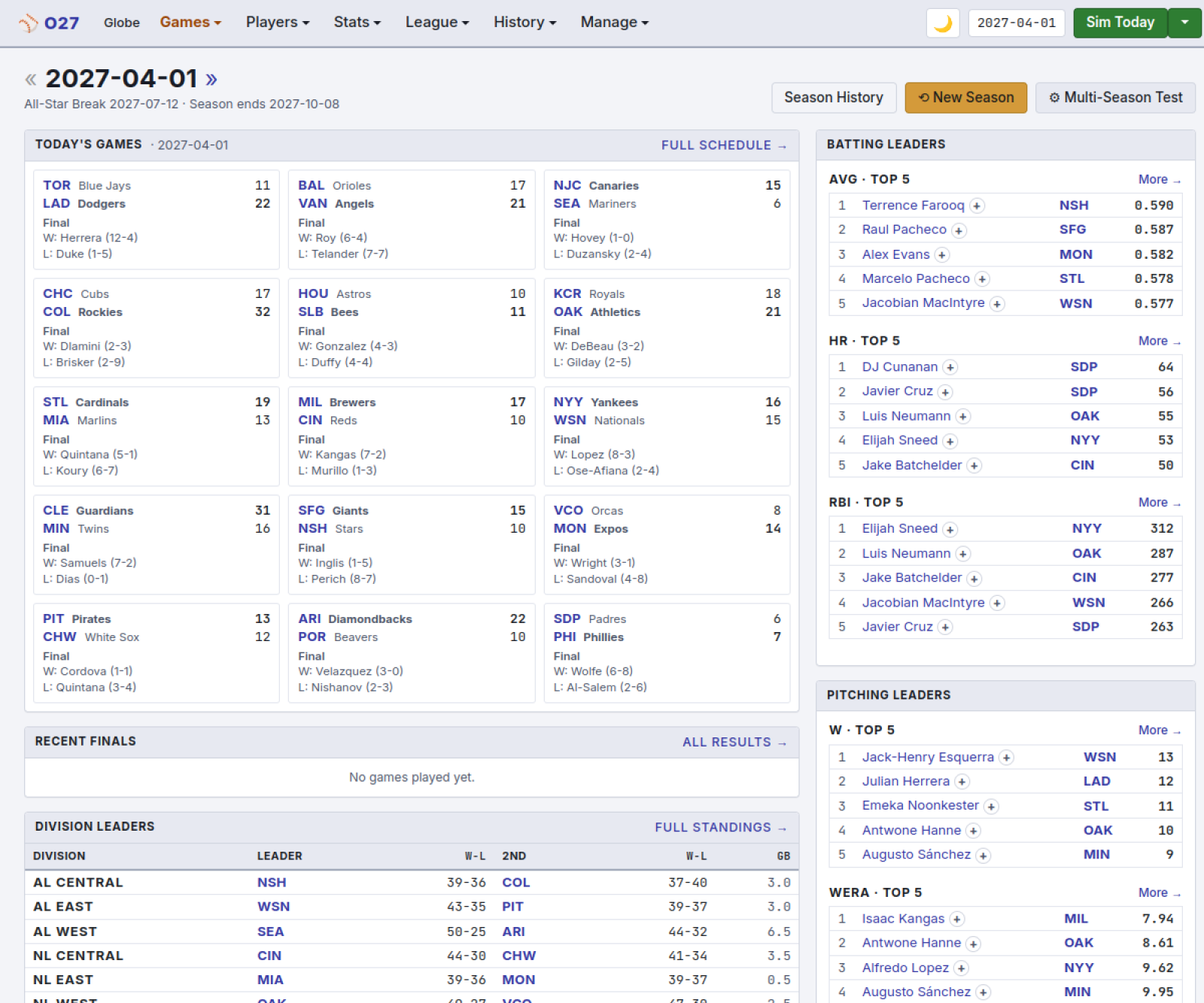
A Baseball-Reference-style browsing app; a Fangraphs-style almanac stats explorer (its own static-site generator and a live blueprint, with sortable heatmap leaderboards and downloadable data bundles); and a newspaper-style box score with Markdown export for LLM-readable game writeups.
The engineering
Deliberately dependency-light. The entire simulation, economy, and analytics stack is hand-rolled.
- Runtime
- Python 3.11+.
- Web
- Flask + Jinja2, server-rendered, with vanilla JavaScript on the client. WCAG-AA light / dark theming with a toggle, grouped navigation, and a mobile-responsive layout.
- Persistence
- SQLite, with an idempotent migration layer and concurrent save files.
- Math
- Pure standard library. Every formula, probability table, and calibration constant is written out and owned.
- Tooling
- A peripheral TypeScript workspace for design mockups and codegen, independent of the Python core.
- Deploy
- Docker on Fly.io with a mounted data volume.
The constraint is the point: every important formula is owned in source.
How I work
The thing I’d point a collaborator to is the discipline around the features.
- Every meaningful change ships with an After-Action Report. Nearly sixty AARs record the ask, the design tradeoffs, the verification numbers, and the honest open gaps. The design history lives in writing.
- Calibration over assertion. New environments get simulated and measured before they ship. A nine-assertion invariant suite has to pass before any release — it catches every mathematically-impossible-stat bug the project has ever shipped.
- Willing to revise the rules when the data argues. Super-innings became 3-out extra innings; the Walk-Back was rebuilt from a one-pitch phantom into a persistent runner. Both driven by what the box score was showing.
- Holding the harder version. When the worldwide-leagues feature risked collapsing into national-character clichés, I rebuilt it so a region’s style emerges from infrastructure and economics, and verified the result.
- Designing for the reader. The whole front end exists to surface what the rules produce for a human or an LLM to interpret.
By the numbers
~59,000 lines of Python · ~60 engineering AARs · 271 commits across two weeks of focused iteration · 53 server-rendered views · 16 league configurations (8 — 56 teams) · a 17-pitch catalog · full 162-game seasons, seed-reproducible end to end.
A note on scope
O27 is a thought experiment with a working build. It’s an instrument for studying what the rules produce. That’s the honest framing, and the one I’d defend: the value here is the systems thinking, the analytical rigor, and the willingness to carry an idea all the way to the point where the data can answer the question.